A Reading Route Through TNU’s Public Identity
Read TNU’s public identity as history by tracing how names, dates, and commemorations shape its account of institutional change over time.
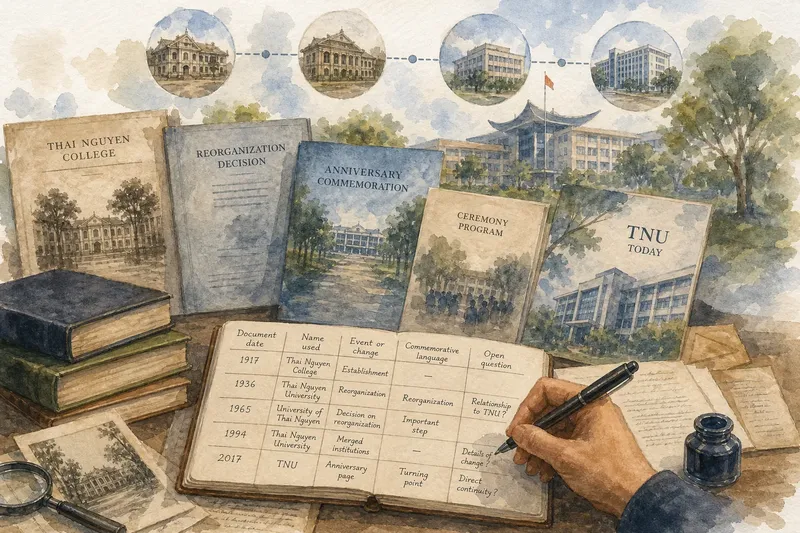
How should you read TNU’s public identity as history without turning a present-day profile into a complete account of the past? Start with one dated name, event, or commemoration, then trace how later accounts describe it. This approach focuses on how institutional memory is made, not on reconstructing every part of the university’s history from scattered pages.
Follow the changing language of institutional memory
A public history does more than list events. Its choice of names, turning points, and commemorative language shows how the institution presents its past at the time the account was written. That makes the account valuable evidence of public memory, even when it does not settle every historical question.
Begin by choosing one phrase that carries historical meaning, such as a former institutional name or a description of an event as a turning point. Record the wording exactly and note the page or document where it appears. Then ask what the phrase emphasizes and what it leaves out.
Keep the historical name visible rather than replacing it with a current one. A name change can signal a change in structure, purpose, or public identity, but resemblance between names alone does not establish a direct relationship.
Build a small timeline around one claim
A focused timeline can reveal how an account develops without becoming a general institutional profile. Use one row for each relevant source, with these fields:
- Document date: If the page or document gives a date, record it; if not, mark it as undated and avoid placing it precisely in the sequence.
- Period described: If the account identifies the period, record it separately from the document date; if it does not, do not assume the two are the same.
- Name used: If a source gives a historical name, retain its exact form; if it does not explain a connection to another name, keep the names separate.
- Event or change: If the source describes a specific event, capture its wording; if it offers only a broad statement, do not turn that into a dated event.
- Commemorative language: If the account assigns significance, attribute that interpretation to the account; if it does not, do not add significance yourself.
- Open question: If a detail remains unclear, write the precise question; if the detail does not affect your claim, leave it out of the timeline.
Say you have a fictional anniversary page that names a reorganization and calls it a turning point, but gives no supporting detail. You enter the page’s publication date, copy the event wording, and record “turning point” as the page’s interpretation. You then find a fictional older institutional record that uses a different name but does not explain its relationship to the reorganization. The resulting timeline shows a commemorative interpretation and an unresolved name connection; it does not support claiming that the older name changed directly into the current one.
Read commemorations for their purpose and omissions
An anniversary page, ceremony program, or institutional memorial is shaped by its occasion. It may foreground continuity, achievement, or shared identity. Those choices are historically meaningful, but they are not a substitute for a record focused on the event itself.
Compare the commemorative account with a source closer to the period it describes, such as a dated institutional document or contemporaneous notice, when one is available. Look for differences in terminology, timing, and emphasis. A later account may use a current name for an earlier period, while an older record may use a title no longer familiar to readers.
Read what the source emphasizes, then note what it does not explain. Do not treat an omission as evidence that an event did not happen; it simply marks a limit in that particular account.
What can a public history establish?
Does a current profile show how TNU describes its past?
Yes. It establishes the wording and interpretation presented in that profile at the time it was issued. For a claim about an earlier event, look for an account that addresses that period directly.
How should I read a phrase such as “turning point”?
Treat it as an interpretation made by the source, not as a neutral description of an event. To assess the wording, compare what the account says changed with records or accounts that describe the event itself.
What if an old name appears without an explanation?
Keep the name in its original form and record where it appears. Do not equate it with a present-day unit unless a source explicitly explains the relationship.
How can I compare accounts from different periods?
Place their publication dates, names, and descriptions side by side, while keeping the period each source discusses distinct from its own date. If they differ, describe the difference and the evidence each provides rather than choosing a version by assumption.
Keep the historical claim narrower than the source
Before using a public account, write the claim you want to make in one sentence. Check that each part is supported by the wording available: a stated date can support a claim about what that account dates, while an attributed interpretation can support a claim about how that account frames the event.
If a source does not identify its evidence, use it to describe the institution’s public memory, not as the sole basis for a broader claim about the past. If accounts leave a name, date, or relationship unresolved, state that limit only where it affects the question at hand.
For a concise reading of TNU’s public identity as history, trace one name or event across accounts from different occasions. The comparison can show how the institution’s account of its past is presented and revised, while keeping the distinction between historical evidence and public remembrance clear.